


If You Share What Is Everlasting
LCW Volunteer Harry Wills writes on the Magi and the Meaning of the Other.
"After Jesus was born in Bethlehem in Judea, during the time of King Herod, Magi from the east came to Jerusalem and asked, ‘Where is the one who has been born king of the Jews? We saw his star when it rose and have come to worship him.’ When King Herod heard this he was disturbed, and all Jerusalem with him. When he had called together all the people’s chief priests and teachers of the Law, he asked them where the Messiah was to be born. ‘In Bethlehem in Judea,’ they replied, ‘for this is what the prophet has written: ‘“But you, Bethlehem, in the land of Judah, are by no means least among the rulers of Judah;for out of you will come a ruler who will shepherd my people Israel.”’
(Matthew 2:1–6)
One of my university teachers told us about the time he spent living in rural Africa. He was the only white Christian in a Muslim community. At first, he felt like a distrusted other’. Yet, they shared their space and resources with him and, by the end, no one could doubt the possibility of co-existence. According to the fear and hatred of ‘otherness’ that has become widespread in Europe, this village ought to have met the visitor with hostility and never have shared their material means with him. Given the history of colonialism in Africa, they certainly had more reason to distrust him than if the situation was reversed.
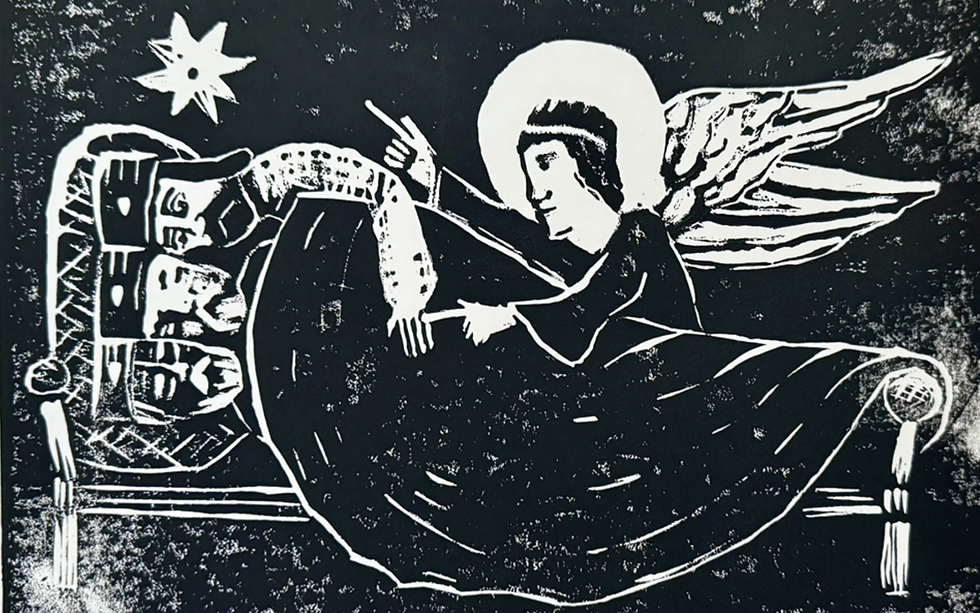
I was reminded of that story when looking at the Nativity according to Matthew. We are told of ‘Magi from the east’. Men from a different country, religion, and language, and who were widely suspected of sorcery. And yet there was something more important than their differences that brought them to the hospitality of a poor Hebrew family in Bethlehem.
Who were they? While there is some doubt, the term refers to Zoroastrian priests. Their religion, Zoroastrianism, was founded by the prophet Zarathustra who, much like Jesus, inspired a radical shift in the mainstream thought of his day, critical of the established order and traditional religious authorities, and promising a future world where evil is overcome by good. The appearance of the Magi in the narrative raises two big questions: What was the significance of Jesus’ birth to them? And what do we learn from it?
First, I would like to mention something about the historic relationship between the two religions. There were, of course, significant cosmological and theological disagreements between them but one of the earliest Christian understandings of Zarathustra was that he “had been an Iranian counterpart of the (idealised) Hebrew prophets and had been sent, like them, to prepare the way for Christ” (Mary Boyce). Later, referring to the increasing influence of Christianity and other religions, the Zoroastrian king, Hormizd IV, is reported as saying “A throne has four legs, and the two inner legs cannot support it without the two outer ones. The religion of the Magi likewise cannot stand without opposition.” His proposed solution – mirroring Matthew 5:16 and 1 Peter 2:12; 3:15–16 – was for Zoroastrians to perform good works in order to draw others to the ‘Good Religion’.
Imagine a world where differences were always settled in this way!
To understand why these Magi might have been interested in Jesus, we can look at their scripture. Yasht 19, for instance:
"...in order that the dead shall rise up, that the Living One, the Indestructible, shall come, the world be made wonderful at his wish…" (Cf. Matt 16:16; Luke 20:38)
"We worship mighty Khvarenah (Divinely-Given Glory)…, which will accompany the victorious World-Saviour and also his other comrades, so that he may make the world wonderful…" (Cf. Matt 19:28; John 3:17, 15:26–27; Acts 10:38)
"He will gaze with eyes of sacrifice on the whole material world, and heedfully will he make the whole world undying…" (Cf. John 6:51)
"Bad Purpose will be overcome, Good Purpose overcomes him. Overcome will be the lie, the truth overcomes it… Perfection and immortality will overcome both hunger and thirst…" (Cf. Matt 5:6; John 6:35, 8:32, 16:33; Rom 12:21)
Consider also this passage from the Greater Bundahishna (34:6) which resembles the Parable of the Sheep and the Goats (Matt 25:31–33):
"the Saviour will raise up all the dead. And all mankind will arise, whether just or wicked… In that assembly, everyone will behold his own good or bad deeds, and the just will stand out among the wicked like white sheep among black…"
Zarathustra prophesied about a Last Day, Final Judgment, and resurrection of the dead (Greater Bundahishna). Texts concerning the Saviour also predict a virgin birth (Yasna 43:3). The World Saviour is a pastor for the poor’
(Ahunvar, cf. ‘Good Shepherd’) and is ordained by God (Yasna 53:2). There are also instructions on charity and warnings against wealth. Given His comparison of the rich with camels trying to pass through a needle’s eye (Luke 18:25), you could say Jesus is also a bit of a zarathustra (lit. ‘he who can handle camels’).
There are good reasons, it seems to me, why Magi were included in the story, with prophecies so reminiscent of our own ‘world saviour’. On one hand, the text mentions their ‘foreignness’ but, on the other, we are drawn to see the common ground. The coming together of different people to share in a future hope.
There are other passages in the New Testament that deal with gentiles, Samaritans, the ‘others’ of various kinds and, in each case, the Teaching draws us closer together. It breaks down perceived differences and reveals what is important, that we are neighbours, a theme summarised by Paul: You are all one in Christ Jesus. (Gal. 3:28) If two people can come together in a shared hope, how different can they really be at heart? As the Christian Didache (1st century) says: ‘If you share what is everlasting, you should be that much more willing to share things which do not last’. Today, however, the fear of the ‘other’ means an unwillingness to share land or wealth with those they see as ‘foreign’. But how foreign can they be? I am willing to bet that, wherever we come from, we share a great deal of what is eternal: A humanity and the hope for a future.
As we can see from the Nativity, one of Jesus’ first acts was to bring the ‘other’ to Him. As He says: I have other sheep that are not of this sheep pen. I must bring them also. (John 10:16)
To Him be the glory and the power, forever. Amen.


