To Shout or not to Shout?
Updated: Apr 2
Community member Naomi writes on noisy protest and what could be gained from a more disruptive Christian witness.

If we have ever met at a protest, you will know that I love making a bit of a ruckus. If someone jumps on the megaphone or starts singing a Billy Bragg song, I will be there singing it at the top of my lungs. While protest can take many forms, an essential part of protest for me is to be disruptive, to be in a physical space and claim ownership of it. But this is not without its limitations; we (and I include myself in this) can be guilty of making noise for noise’s sake. Speaking from personal experience, sometimes the most disruptive protest can be entirely silent.
I have been thinking a lot about how we occupy this physical space, particularly as Christians. In particular, what is the role of Christians in those spaces? Are we there to bring peace, to simply be there as a sign of solidarity with the cause, making the other protesters know that we are “not like other Christians”? Is it enough for us to just be there, or do we also need to be willing to be disruptive?
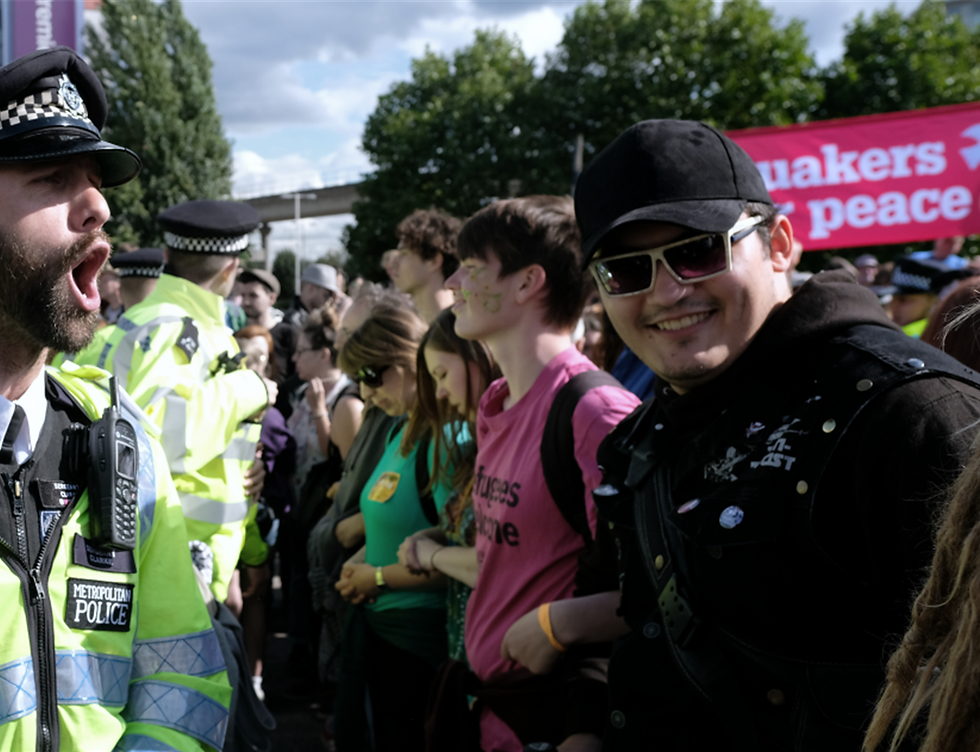
Since joining the Catholic Worker, there have been three protests that have made me ponder the efficacy of noisy protest. The first was at the DSEI Arms Fair in September, a staple in the life of the London Catholic Worker. Every two years at the opening of one of the largest arms fairs in the world, people of all faiths and none descend on the Excel Centre as a visible witness to the horrors of the arms trade. We began our time there with a Quaker meeting for worship (perhaps the most obvious example of silent witness). I have often found meetings for worship moving, particularly when they are held in public. There was a moment when we became surrounded by police officers threatening to move us on. As an act of non-violent witness, a friend stood up and welcomed the police officers to the meeting. You could argue that this wasn’t particularly effective – we weren’t part of the group of protesters who were blocking the entrance to the arms fair, for example – but the stillness in that space felt similar to the moment of stillness Elijah experienced on Mount Horeb. In that moment, I experienced God not in the violence of the arms fair, but in a “moment of sheer silence” (1 Kings 19:12).
Buoyed up by this moment of stillness, I felt empowered to join a group of protesters outside the exit of the Excel Centre for a very different type of disruption. There we were as the attendees were leaving the fair, shouting “shame! shame on you!” At the time, I felt some discomfort doing this. I could see that some of the other people of faith remained silent, not engaging with the chanting. And who was I, a fellow sinner, to bring shame on people just doing their jobs? But in doing this, we engaged far more with the attendees than with the meeting for worship. The disgruntled attendees stopped and asked why we were shaming them, pushing back against us. Would we have had the same response if we had stood there in silence? After all, didn’t Jesus speak uncomfortable truths to the authorities of his time (Matthew 23)? Didn’t he also make a ruckus in the Temple (John 2:3–16) and, like the persistent widow in Luke 18, teach us to make our presence felt?
Another example comes, once again, from the Quakers, during the October Defend our Juries action in Trafalgar Square. The Quakers decided to hold meetings for worship every hour on the hour for the duration of the demonstration. This was in response to a call for a silent demonstration, certain that the disruptive nature came from the words on the placards the sitters were holding. About halfway through the day, a group of socialist organisers set up camp next to us and got thoroughly disgruntled with what we were doing. One of them got on a megaphone, shouting at us: “why are you silent? This is not the time for silence! Now is the time for action! Your silence makes you complicit!” It seems that silent contemplation can really annoy some comrades...
A few weeks after this, I attended an anti-fascist demo in Whitechapel. The local community had successfully stopped UKIP from marching through a predominantly South Asian area of London. Despite the fact UKIP had moved their march to Hyde Park, the anti-fascist organisers decided to stay in Whitechapel and keep a presence there. There were so many anti-fascist demonstrators that we filled Whitechapel High Street, occupying the road for a few hours at least. Despite the police trying to contain it, they couldn’t stop us shouting, marching, dancing and, yes, even singing Billy Bragg songs. Walking away from the demo I experienced an unexpected moment of stillness; because the High Street had been blocked, all I could hear on my walk back to the tube was the sound of birdsong and the market-sellers. I found myself thinking about Psalm 62:
“Wait on God alone in stillness, O my soul; for in him is my hope.”
(v. 7)
In that moment, all I wanted to do was give thanks for the beauty of this moment but also the holy actions of the demonstrators that made this peace possible.
I don’t write this to have a definitive answer on whether we should be noisy at protests or not; perhaps it depends on what the situation demands. Even so, I offer this as a provocation to those of us who might want to avoid the discomfort of disruptive protest. So often I have found us Christians are reticent to be disruptive, resorting to candlelit vigils and silent prayer. I often wonder what the church would look like if we preached a gospel of noisy disruption. Imagine if our preachers told us to pick up a placard, grab your megaphone and take to the streets, the place where Christ is so often found. The Book of Proverbs reminds us to “speak out for those who cannot speak, for the rights of all the destitute” (Proverbs 31:8). Perhaps a bunch of noisy Christians would do the world a whole lot of good.